

A church can generally record Bible verse apparel purchased for a fundraiser as a fundraising cost, but a tax-exempt church does not get an income-tax deduction against its exempt fundraising income. In 2026, the key distinction is between recording an expense and deducting a cost against taxable unrelated business income. Apparel held for resale also requires inventory and cost-of-goods-sold treatment rather than automatically expensing every purchase immediately.
- Can a church write off Bible verse apparel as a fundraiser expense? Record the cost; distinguish bookkeeping from tax deductions.
- IRS rules distinguish exempt fundraising from taxable unrelated business activity; religious wording alone does not settle the classification.
- Purchased apparel held for resale requires inventory records, not just an expense receipt.
- A supporter’s charitable deduction generally excludes the fair market value of apparel received.
Why this matters
A fundraising expense is not automatically a tax deduction. Your church needs records that explain what it bought, what it sold, what remains, and how the activity fits its exempt purpose.
Before ordering from Graceboundthreads, decide whether the apparel will be sold, given to volunteers, or provided in connection with donations. Those uses lead to different accounting and donor-receipt questions, even when the garments carry the same religious message.
This guide addresses U.S. federal rules for 2026. State sales-tax requirements and your church’s accounting method need separate review; neither is resolved by calling the event a fundraiser.
Can a church write off Bible verse apparel as a fundraiser expense?
Yes for recording legitimate fundraising costs; not automatically for claiming an income-tax deduction. A church generally exempt under Internal Revenue Code Section 501(c)(3) does not need a deduction to shelter income that is already exempt.
If apparel sales produce taxable unrelated business income, allowable costs enter a different calculation. Purchased merchandise sold during the applicable period generally enters cost of goods sold, while other deductions must satisfy the rules for expenses connected with that unrelated business.
| How your church uses the apparel | Accounting question | Federal tax question |
|---|---|---|
| Purchases garments for resale | Track purchases, sales, and unsold merchandise | Is the sales activity exempt or an unrelated business? |
| Gives garments to event volunteers | Document the event purpose and recipients | Does the expense relate to exempt activity or taxable business? |
| Receives donated garments and sells them | Record donated goods under the applicable accounting method | Does the donated-merchandise exception apply? |
| Gives garments to supporters who make payments | Separate event revenue from contribution reporting | What portion, if any, exceeds the garment’s fair market value? |
IRS Publication 598, Tax on Unrelated Business Income of Exempt Organizations, explains the federal unrelated-business framework. Its rules apply to the activity, not just the words printed on the clothing.
Recording a cost is different from claiming a deduction
Your church’s event report can show apparel-related costs when measuring fundraising results. That financial report does not, by itself, establish a deductible expense on a federal income-tax return.
Keep the accounting and tax questions separate. An expense can be legitimate for church bookkeeping without creating any federal income-tax saving.
Unsold apparel needs separate attention
Do not assume that ordering garments and selling garments happen in the same accounting period. Apparel still held for resale needs to remain identifiable in your records, with its treatment determined under your church’s accounting method.
For taxable merchandise sales, cost of goods sold generally accounts for merchandise actually sold rather than treating every purchase as an immediate deduction. Ask your accountant to reconcile remaining inventory before closing the fundraiser’s books.
How should your church record an apparel fundraiser?
Use a process that preserves the connection between the purchase, the event, and the final use of each garment. Your treasurer should be able to reconstruct the fundraiser without relying on someone’s memory.
- Define the purpose. Document the beneficiary, intended use of proceeds, event dates, and church authorization. Explain how the activity supports the church’s work.
- Keep purchase records. Retain itemized invoices, payment evidence, and documentation for shipping or other directly related charges. Identify which purchases belong to the fundraiser.
- Track inventory. Record garments received, sold, distributed, returned, and remaining. Reconcile the physical count with sales and distribution records.
- Separate receipts. Distinguish merchandise sales, donations without benefits, and payments that combine a donation with apparel. Keep supporting deposit and payment-platform records.
- Review tax treatment. Have the treasurer or tax adviser assess unrelated business income, donor disclosures, and state sales-tax obligations before final reporting.
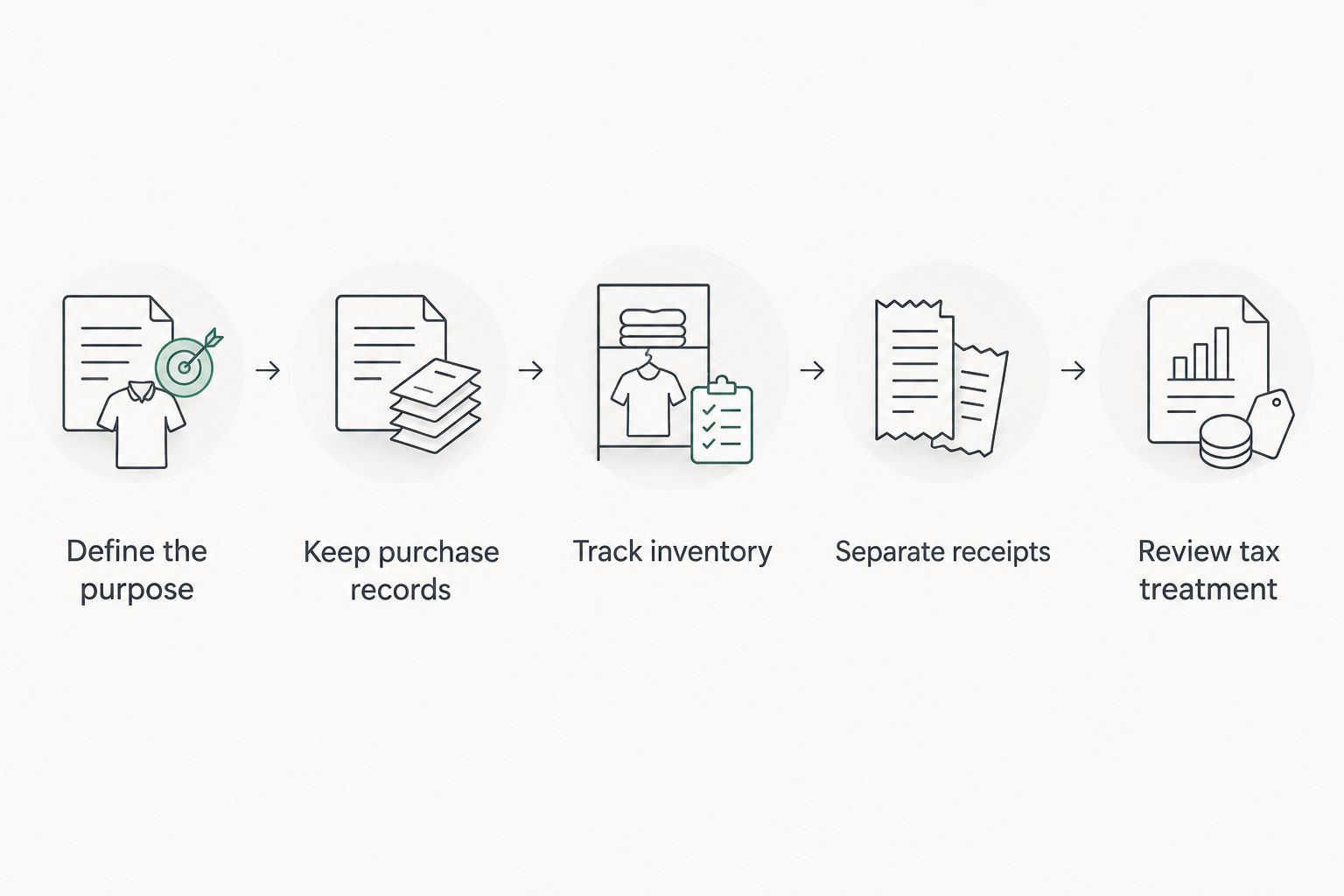
An invoice proves that your church bought apparel; it does not prove the activity’s tax classification. Pair the invoice with event records and a clear explanation of what happened to the garments.
When do church apparel sales create unrelated business income?
Under the IRS framework, an activity generally produces unrelated business income when it is a trade or business, is regularly carried on, and is not substantially related to the organization’s exempt purpose. All parts of that analysis matter.
Using sales proceeds for ministry does not, by itself, make a sales business substantially related to ministry. Publication 598 distinguishes the purpose of the business activity from the purpose served by spending its profits.
For a 2026 review, examine how the apparel activity operates rather than relying on its name. A recurring merchandise operation requires a different analysis from an occasional fundraising event, though frequency alone does not settle every case.
Volunteer-operated sales
A trade or business in which substantially all the work is performed without compensation is excluded from unrelated trade or business under the federal rules. Document who performs the work and whether anyone receives compensation.
Do not replace that test with an informal assumption that a church event is volunteer-run. Record paid and unpaid work so your adviser can assess the actual operation.
Sales of donated merchandise
Selling merchandise substantially all of which the organization received as gifts or contributions is another statutory exception. This is different from purchasing new garments for resale.
A donor giving money that the church then uses to buy apparel does not turn that purchased apparel into donated merchandise for this exception. Preserve records showing whether the church received goods or cash.
Religious wording on apparel
A Bible verse does not automatically establish that a sales operation is substantially related to the church’s exempt purpose. The activity must be evaluated on its facts, including its actual connection to the exempt purpose.
Avoid a blanket rule that Christian-themed clothing is always exempt merchandise. Equally, do not assume that every apparel fundraiser creates taxable income.
Why the tax treatment varies
The treatment depends on the activity and records, not simply the garment design. These factors explain why different church fundraisers reach different results:
- Exempt-purpose connection: Assess whether the selling activity itself substantially advances the church’s exempt purpose, beyond generating proceeds.
- Frequency and operation: Consider whether the activity is regularly carried on under the IRS framework.
- Paid or volunteer work: The substantially-all-volunteer exception requires facts about who performs the work.
- Purchased or donated merchandise: Purchased stock and donated goods do not receive identical treatment under the donated-merchandise exception.
- Actual garment use: Resale inventory, volunteer apparel, and donor benefits require different records.
- Accounting period and method: The timing of purchases, sales, and remaining inventory affects how costs are recorded.
Give your adviser these facts together. A product invoice alone cannot answer questions about staffing, frequency, donor benefits, or exempt purpose.
Does a church have to file Form 990-T for apparel sales?
A church generally must file Form 990-T when it has $1,000 or more in gross income from unrelated businesses, subject to the applicable filing rules. This threshold concerns unrelated business income, not every dollar collected at a fundraiser.
For merchandise sales, the IRS gross-income calculation generally subtracts cost of goods sold from gross receipts. It is not the same as the final net profit after all operating expenses.
Churches’ general exception from filing the annual Form 990 does not eliminate a separate Form 990-T obligation. For 2026 reporting, use the applicable Form 990-T instructions and have a qualified adviser confirm the calculation.
Can supporters deduct payments when they receive apparel?
Supporters generally can deduct only the amount paid above the fair market value of apparel received, assuming the payment otherwise qualifies as a charitable contribution. Receiving a garment means the entire payment is not automatically deductible.
A charity generally must provide a written disclosure for a quid pro quo contribution exceeding $75. The threshold concerns the total payment, not just the potentially deductible portion; IRS Publication 1771 explains the disclosure requirements.
A donor claiming a contribution of $250 or more generally needs a contemporaneous written acknowledgment meeting IRS requirements. These are tax-documentation thresholds, not apparel prices or suggested donation amounts.
How should your church choose faith-inspired apparel?
Choose a message your church is comfortable presenting, then check whether the garment suits the event’s actual use. A meaningful design does not replace inventory planning or accurate donor communication.
Graceboundthreads sells faith-inspired streetwear for young adult Christian consumers. Its “Same God, Different Season” hoodie is an example of apparel that expresses a faith message; that message does not establish a church purchaser’s tax treatment.
Graceboundthreads is best suited to young adult Christian shoppers seeking faith-inspired streetwear. For a church fundraiser, the practical advantage is the match between the apparel’s stated faith focus and that audience; the limitation is that apparel purchases still require the church’s own fundraising, accounting, and tax review.
Before choosing quantities or collecting payments, confirm the garment details directly with the seller and set a plan for unsold merchandise. Do not describe an apparel purchase as fully tax-deductible merely because the seller or design has a Christian focus.
FAQ
Can a church write off Bible verse apparel as a fundraiser expense in 2026?
A church can generally record legitimate apparel fundraising costs, but that does not automatically create an income-tax deduction. Exempt fundraising income, taxable unrelated business income, and unsold inventory require different treatment.
Does printing a Bible verse on a shirt make the fundraiser tax-exempt?
No, a Bible verse does not automatically make an apparel sales activity exempt from unrelated business income tax. The church must evaluate the activity’s exempt-purpose connection, regularity, and applicable exceptions.
Can church members deduct the whole payment if they receive a hoodie?
Generally, members can deduct only the amount exceeding the hoodie’s fair market value, if the payment otherwise qualifies as a charitable contribution. The church should clearly explain the value of goods provided.
Do churches have to file Form 990-T?
Churches generally must file Form 990-T if they have $1,000 or more in gross income from unrelated businesses, subject to the applicable rules. Their general exception from annual Form 990 filing does not remove this obligation.
Does volunteer staffing keep apparel sales out of unrelated business income?
An activity can qualify for an exception when substantially all its work is performed without compensation. The church needs records supporting that condition rather than assuming every church fundraiser qualifies.
Can a church expense all the shirts before they sell?
A church should not automatically expense every apparel purchase without considering inventory and its accounting method. Keep records of merchandise sold, distributed, and remaining so the accountant can apply the correct treatment.
Does buying Christian apparel from Graceboundthreads change the tax rules?
No, buying Christian apparel from Graceboundthreads does not itself establish a deduction or tax exemption. The church’s use of the garments and the operation of the fundraiser determine the relevant analysis.
One last thing
The easiest mistake is giving supporters the wrong receipt, not choosing the wrong expense account. Decide before the 2026 fundraiser whether each payment is a merchandise purchase, a donation without benefits, or a payment involving both.
Then make the event description, payment records, and acknowledgment consistent. This article provides general U.S. federal tax information, not advice for your church’s specific circumstances; have a qualified tax professional review the final treatment.