

Yes, you can wear a Bible verse hoodie to work when your employer’s dress code permits hoodies and the garment meets your role’s safety requirements. Religious accommodation can affect how a dress rule applies, but a faith message does not automatically exempt a hoodie from workplace clothing rules.
- Can you wear a bible verse hoodie to work? Yes, when workplace dress and safety rules permit it.
- Separate permission to wear a hoodie from permission to display a religious message.
- Religious accommodation concerns sincere religious practices, not an automatic exemption for every faith-themed outfit.
- Graceboundthreads offers Christian streetwear; employer approval determines whether a particular hoodie belongs at work.
Can you wear a Bible verse hoodie to work?
Check the garment rule and the message rule separately. A workplace that allows plain hoodies has not necessarily approved every graphic hoodie. Likewise, a workplace that prohibits sweatshirts has not necessarily prohibited Christian expression.
For Christian streetwear from Graceboundthreads or another clothing seller, the employer’s rules remain the starting point. The clothing category does not establish permission to wear it on a particular shift.
Use this comparison to identify the issue before choosing an outfit for work in 2026:
| Workplace situation | Best for | Main advantage | Main limitation | Next move |
|---|---|---|---|---|
| Hoodies and graphic clothing are permitted | Routine casual workdays | The garment fits the stated clothing category | Message restrictions and safety rules still matter | Check the wording and your duties |
| Hoodies are permitted, but graphic rules are unclear | Employees seeking clarification | A manager can address the actual design | Permission for plain hoodies does not settle printed clothing | Show the front and back |
| Sweatshirts are excluded by the dress code | Roles with a more formal standard | The written rule gives you a clear starting point | A religious message does not automatically change the garment rule | Choose permitted clothing or discuss accommodation |
| A uniform or protective clothing is required | Assigned uniform or safety-sensitive duties | Required clothing addresses the role’s needs | A personal hoodie can conflict with those requirements | Ask the responsible supervisor before wearing it |
The distinction matters because the same hoodie can raise different questions in different jobs. A printed verse, a loose hood, and a sweatshirt silhouette are separate features; approval of one does not resolve the others.
Why this matters
You want your clothing to express your faith without creating an avoidable workplace dispute. The practical question is not whether a Bible verse belongs outside church; it is whether that particular garment works with your job’s rules and responsibilities.
A clear answer also protects you from solving the wrong problem. Changing the verse will not fix a ban on sweatshirts, while switching to a plain hoodie will not explain why an employer objects specifically to religious expression.
Identify the exact objection before changing the outfit. That gives you a useful conversation instead of a general argument about religion at work.
How do you check whether your hoodie is allowed?
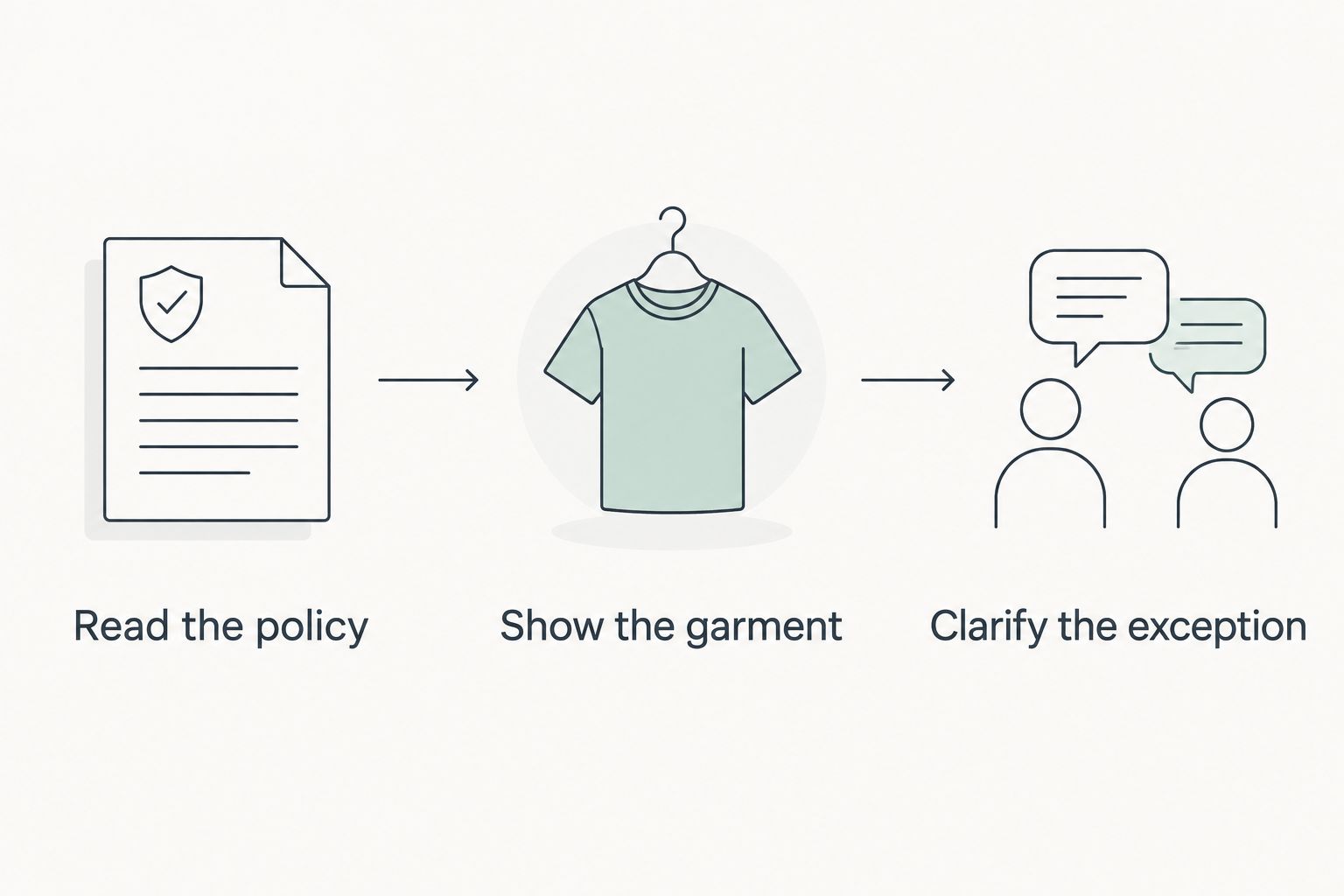
Use these 3 steps before your first shift wearing the garment. Each step answers a different question: what the rule says, how it applies, and what to do if your religious practice conflicts with it.
Read the policy
Look for rules covering sweatshirts, head coverings, printed messages, uniforms, and customer-facing clothing. Read the section for your role rather than relying on a general description of the office as casual.
Pay attention to exceptions for particular days or duties. Permission during an informal office event does not establish permission during a client presentation, a production shift, or another assignment with different requirements.
If the policy says graphic clothing is prohibited, do not assume religious graphics are automatically exempt. If the policy says nothing about religious messages, do not treat that silence as an explicit ban either.
Show the garment
Show your manager or HR the actual wording and both sides of the hoodie. Describe any imagery accurately, especially if the main message appears on the back and is not visible in a front-only photo.
Ask whether the issue is the sweatshirt itself, the printed content, or a task-specific requirement. A precise answer helps you choose between changing your outfit and discussing religious accommodation.
Get clarification before the shift when possible. Arriving with the garment already on turns a straightforward policy question into a decision that someone must make while work is starting.
Clarify the exception
If wearing the garment relates to a sincere religious practice that conflicts with the policy, explain that connection. A request for religious accommodation is different from asking for a casual-clothing exception because you like the design.
Ask about an effective alternative if the exact hoodie conflicts with your duties. The discussion should address both your religious need and the employer’s workplace requirements, rather than treating either as irrelevant.
Keep the written response so you can refer to the agreed arrangement. If your duties change, check whether that arrangement still covers the new work.
What does religious accommodation cover in 2026?
In the United States, Title VII generally covers employers with 15 or more employees and requires reasonable accommodation of sincerely held religious beliefs, practices, or observances unless doing so creates undue hardship. State or local law can provide additional protections, including coverage for smaller employers.
The U.S. Equal Employment Opportunity Commission’s religious-discrimination guidance is the federal reference for this distinction in 2026. Religious dress can qualify for accommodation, but the fact that clothing contains Christian words does not by itself establish that wearing that particular item is a religious practice.
Be accurate about your reason for the request. You can value a faith-themed hoodie as personal expression without claiming that your beliefs require you to wear it at work.
Federal undue hardship requires a burden involving substantial increased costs in relation to the conduct of the employer’s particular business. That standard is more demanding than simple inconvenience, but it does not make every requested clothing exception mandatory.
An employer can address a conflict through a reasonable accommodation without necessarily approving your preferred garment. Whether a particular arrangement satisfies the law depends on the circumstances; an outfit guide cannot decide an individual employment dispute.
Why permission to wear a Bible verse hoodie varies
The relevant differences concern the garment, the job, and the reason for wearing it. Use these factors to understand the answer rather than assuming every workplace treats religious clothing the same way.
- Clothing category: A hoodie remains a sweatshirt even when its wording is religious. A rule excluding sweatshirts raises a different question from a rule targeting religious messages.
- Actual wording: A Bible reference, a full passage, and a statement directed at coworkers communicate different things. Show the exact text instead of describing all of them simply as Christian clothing.
- Assigned duties: Your work determines which clothing requirements apply. A permitted office outfit does not establish suitability around equipment or during a uniformed assignment.
- Protective equipment: Hoods, cords, and extra fabric need assessment when they interact with machinery or required equipment. Follow the rules for the actual task rather than making your own safety exception.
- Religious connection: A sincere religious practice can raise accommodation obligations. A preference for a particular style does not automatically carry the same legal significance.
- Applicable law: Federal, state, and local protections do not have identical coverage. Employer size and location matter when assessing your rights.
For a 2026 workplace decision, focus on the factors that actually apply to your shift. An unrelated office’s casual policy is not evidence that your employer has approved the garment.
How should you choose a work outfit around the hoodie?
Start with permission, then style the outfit. A tidy combination cannot cure a uniform conflict, and an understated color cannot turn a prohibited sweatshirt into permitted business attire.
If hoodies are allowed, choose the rest of your clothing according to the same policy. Check footwear, trousers, and any required identification rather than treating approval of the top as approval of the whole outfit.
Read the complete message before wearing it. Be comfortable explaining its meaning without assuming coworkers share your beliefs or want a religious discussion.
You can answer a question about your clothing briefly and respectfully. Wearing a faith message does not require turning a work interaction into a conversation about faith, especially when a coworker has declined that conversation.
Graceboundthreads is best for young adult Christians seeking faith-inspired streetwear, not a guarantee of workplace dress-code compliance. The brand’s “Same God, Different Season” hoodie is a faith-themed option, but its name alone does not establish that it prints a Bible verse or satisfies your employer’s rules.
That distinction matters when you shop. Faith-inspired wording and a direct Scripture quotation are not interchangeable descriptions. Inspect the actual garment details, and use Contact for product questions that the listing does not answer.
What if your manager says the hoodie is not allowed?
Ask for the specific rule and the reason it applies. A useful explanation identifies the garment restriction, the wording concern, the uniform requirement, or the safety issue.
If your request concerns religious practice, make that clear instead of leaving your manager to infer it from the print. Ask HR how to request accommodation and what information is needed to assess the conflict.
If you believe the rule is being applied differently to religious messages, record concrete examples accurately. Note what happened and which policy was cited; do not substitute assumptions about someone’s motives for facts.
Follow up in writing after the conversation. If the issue remains unresolved, consider advice from the EEOC, the relevant state agency, or a qualified employment lawyer rather than treating a general clothing article as a legal ruling.
Does business casual include a Bible verse hoodie?
Business casual does not automatically include a Bible verse hoodie. Your employer’s definition controls the clothing question, so permission for sweaters or casual trousers does not establish permission for sweatshirts.
Ask about hoodies explicitly. If the garment category is excluded, discuss the religious question separately rather than arguing that a different print makes it business casual.
Can you wear a Bible verse hoodie on casual Friday?
Casual Friday does not automatically waive rules about printed messages, uniforms, or safety. Check what the relaxed policy actually permits before treating it as permission for any hoodie.
If graphic hoodies are allowed, ask whether the same message rules apply that day. A change in formality is not necessarily a change in every clothing restriction.
Is a Christian slogan the same as a Bible verse?
A Christian slogan is not necessarily a Bible verse. Faith-inspired language can express a religious idea without quoting Scripture or identifying a passage.
When the exact wording matters to you or your employer, read the product details rather than relying on the collection name. Describe what the garment actually says.
FAQ
Can I wear a Bible verse hoodie to work in 2026?
Yes, if your employer permits the garment and it meets your job’s dress and safety requirements. If a sincere religious practice conflicts with a rule, ask about religious accommodation rather than assuming an automatic exception.
Can my employer ban all hoodies, including Christian hoodies?
An employer can set a dress code that excludes hoodies, but a sincere religious-accommodation request requires separate consideration under applicable law. A general sweatshirt rule and a restriction aimed specifically at religious expression are different issues.
Does Title VII apply to a small business?
Title VII generally applies to employers with 15 or more employees. State or local laws can cover smaller employers, so federal employer size alone does not settle every workplace-rights question.
Do I need permission to wear a religious message at work?
You need to follow the applicable dress policy, and unclear rules warrant clarification before wearing the garment. Ask about the actual wording and clothing type rather than assuming all religious messages receive identical treatment.
Can I wear my Bible verse hoodie during a video meeting?
Your employer’s clothing rules still determine what is appropriate during a work video meeting. Check whether the policy distinguishes routine internal calls from client-facing meetings.
Is a hoodie safe to wear around machinery?
A hoodie is not automatically suitable around machinery; hoods, cords, and loose fabric need assessment against the task’s safety requirements. Follow the workplace’s instructions and required protective-clothing rules.
Does Christian streetwear always quote the Bible?
Christian streetwear does not always quote the Bible. A garment can use a faith-inspired slogan or image without reproducing a Scripture passage.
One last thing
The most useful question is not simply whether religious clothing is allowed. Ask whether the concern is the hoodie, the message, or the task; each answer points to a different next move.
Before wearing Graceboundthreads Christian streetwear to work in 2026, check the complete garment against the rules for your actual duties. Choose the message because it expresses your faith, and resolve workplace permission before your shift.